Govern before you automate.
BPMS.Ai helps enterprises run governed intelligent operations across workflows that involve people, systems, documents, robots, and AI agents — with policy control, human escalation, and traceability at runtime.
For operations, transformation, and enterprise architecture leaders coordinating humans, RPA workers, and AI agents under enforceable policy.
Deployed in enterprise environments. Not self-serve. Not a prototype.
1. Enterprise Systems
BPMS.Ai Central Platform
3. AI Agents Ecosystem
4. Human Decision Layer
Orchestration Layers
People · Systems · Data · Documents · AI
Traceable
Every decision audit-ready
Deployed
Production environments
Enforced at Runtime
Not post-hoc
The Problem
Your operations are growing faster than your ability to govern them.
More workflows, more systems, more AI — and less visibility, less control, less confidence that the right things happen the right way.
Fragmented workflows
Critical processes span multiple systems with no unified execution path or single source of truth.
Disconnected handoffs
Work moves between teams through email and ad hoc coordination — creating gaps, delays, and dropped tasks.
AI outside governance
AI agents operate outside controlled processes — no escalation policies, no audit trails, no boundaries.
Weak traceability
When auditors ask 'who decided what, when, and why,' most organizations reconstruct the answer instead of retrieving it.
Governance as afterthought
Compliance checks happen after execution, not during it. Policies live in documents, not in the workflow engine.
Complexity that doesn't scale
Every new process or integration adds overhead that existing tools weren't designed to absorb.
What BPMS.Ai Is
Not a BPM suite. Not an RPA tool. Not an AI agent framework. The governed layer that coordinates all of them.
Enterprises don't suffer from a lack of automation. They suffer from automation without governance. BPMS.Ai is the orchestration layer where humans, enterprise systems, documents, RPA bots, and AI agents execute inside the same governed workflow — with explicit roles, boundaries, escalation paths, and audit-ready traceability.
BPMS.Ai is not
Not a generic BPM suite — process modeling alone doesn't govern AI or RPA participation
Not an RPA platform — BPMS.Ai orchestrates bots, it does not build or replace them
Not an AI agent framework — agents run inside bounded, governed workflows, not autonomously
Not a chatbot, automation suite, or thin AI wrapper on existing tools
BPMS.Ai is
The governed orchestration layer that coordinates people, enterprise systems, documents, robots, and AI agents inside one workflow
An execution layer where every actor — human, system, RPA bot, or AI agent — operates with scope, permissions, and boundaries
A platform where policy enforcement, human escalation, and full traceability are built into runtime, not added afterwards
Designed for enterprise operations that need to adopt AI and automation without losing control or accountability
Product Execution Model
Run intelligent operations under control.
BPMS.Ai is the governed execution layer where enterprise workflows move from intake to audit-ready traceability in five structured steps — with policy enforcement and human escalation built into runtime.
Intake
Work enters BPMS.Ai from forms, portals, APIs, emails, systems, schedules, or manual requests.
Orchestration
BPMS.Ai routes work across people, systems, documents, robots, AI agents, and decision rules.
Governance
Policies, permissions, approval gates, SLA rules, escalation thresholds, and AI boundaries are enforced during execution.
Human Escalation
When exceptions, low-confidence outputs, risk thresholds, or policy requirements appear, work routes to accountable human decision-makers.
Traceability
Every action, decision, document, robot execution, AI output, and human intervention is logged for audit, review, and improvement.
Product
Purpose-built for operational control.
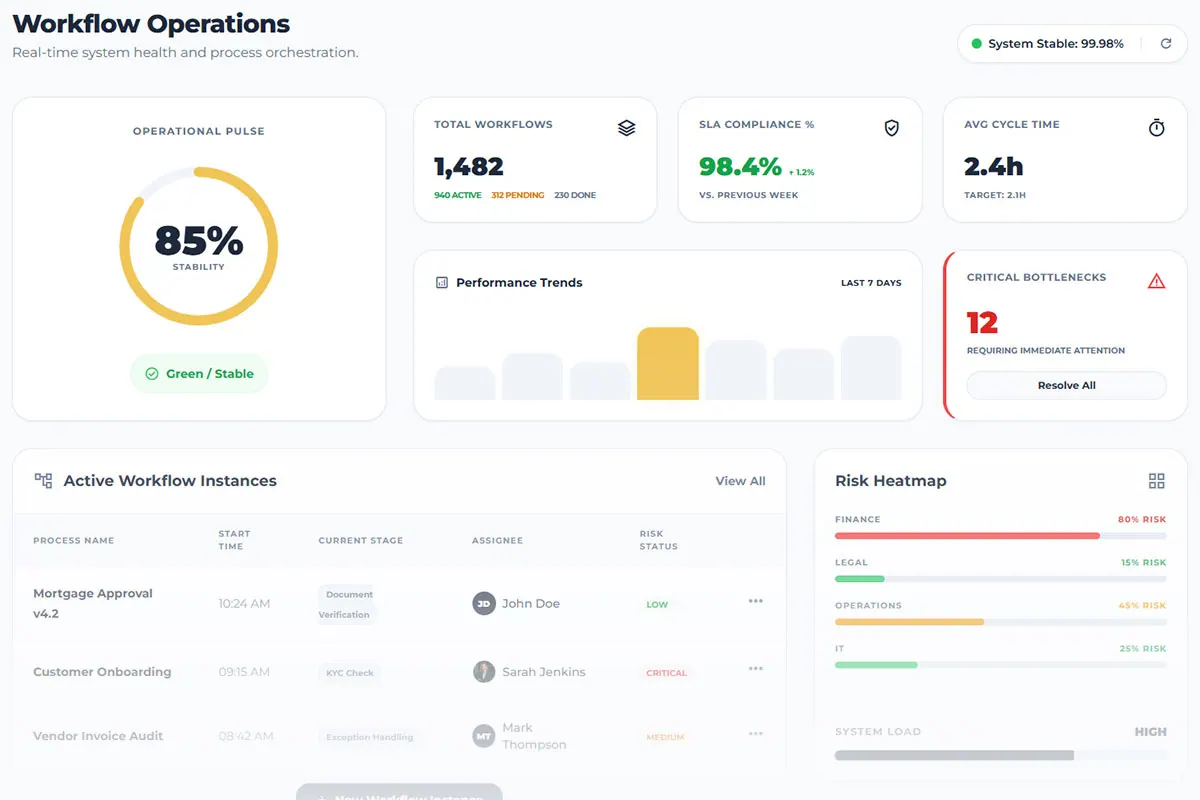
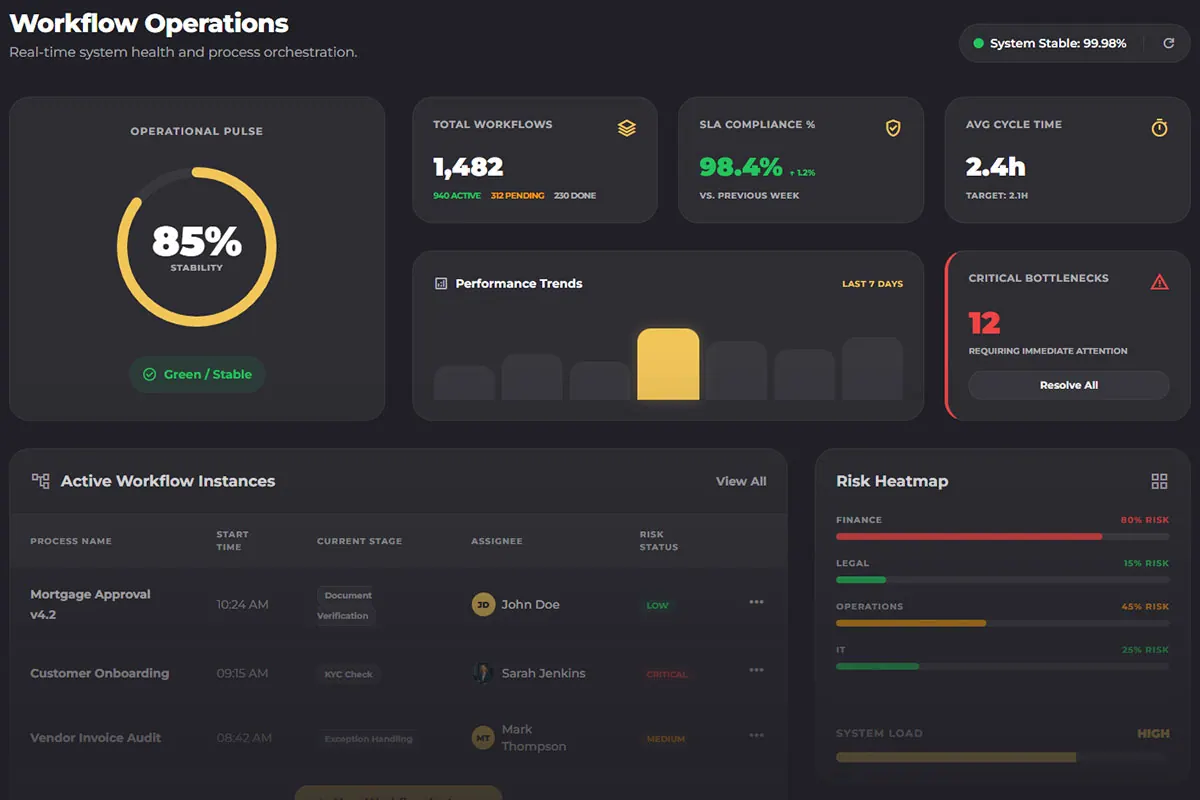
Workflow Control Center
Centralized view of all active, pending, and completed workflow instances with real-time status and operational metrics.
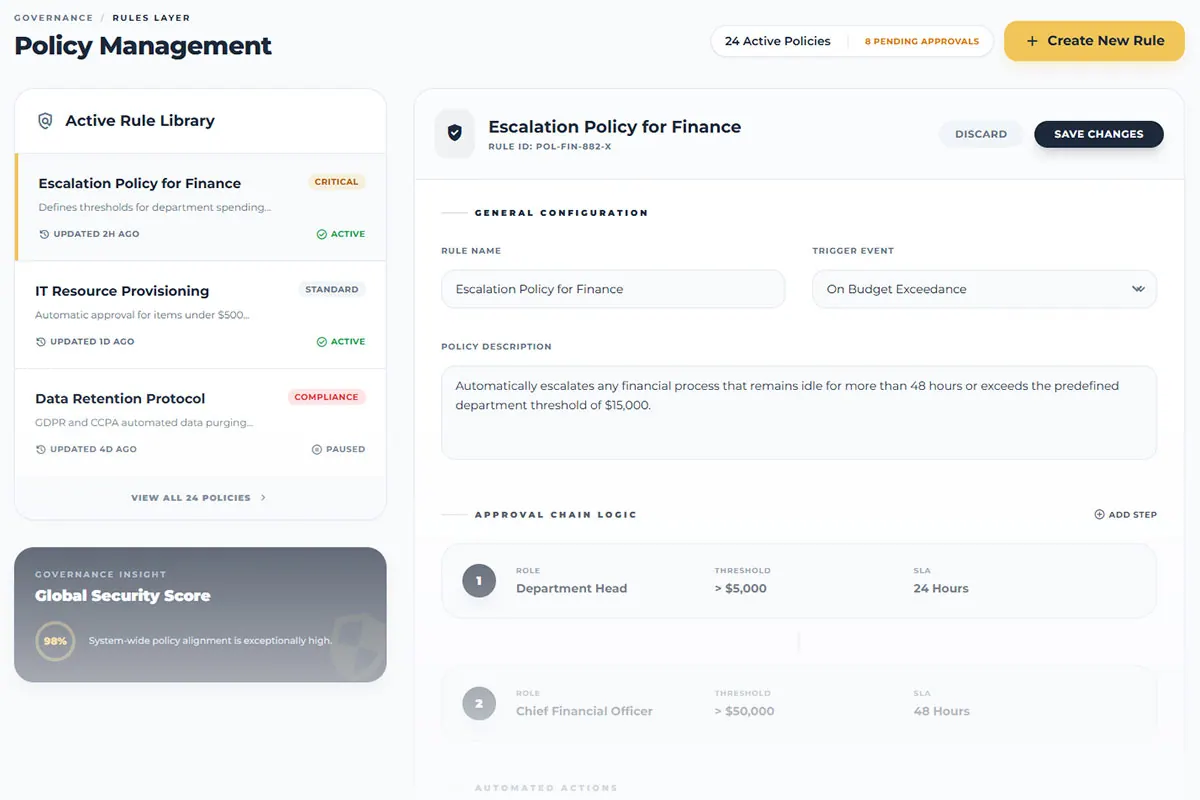
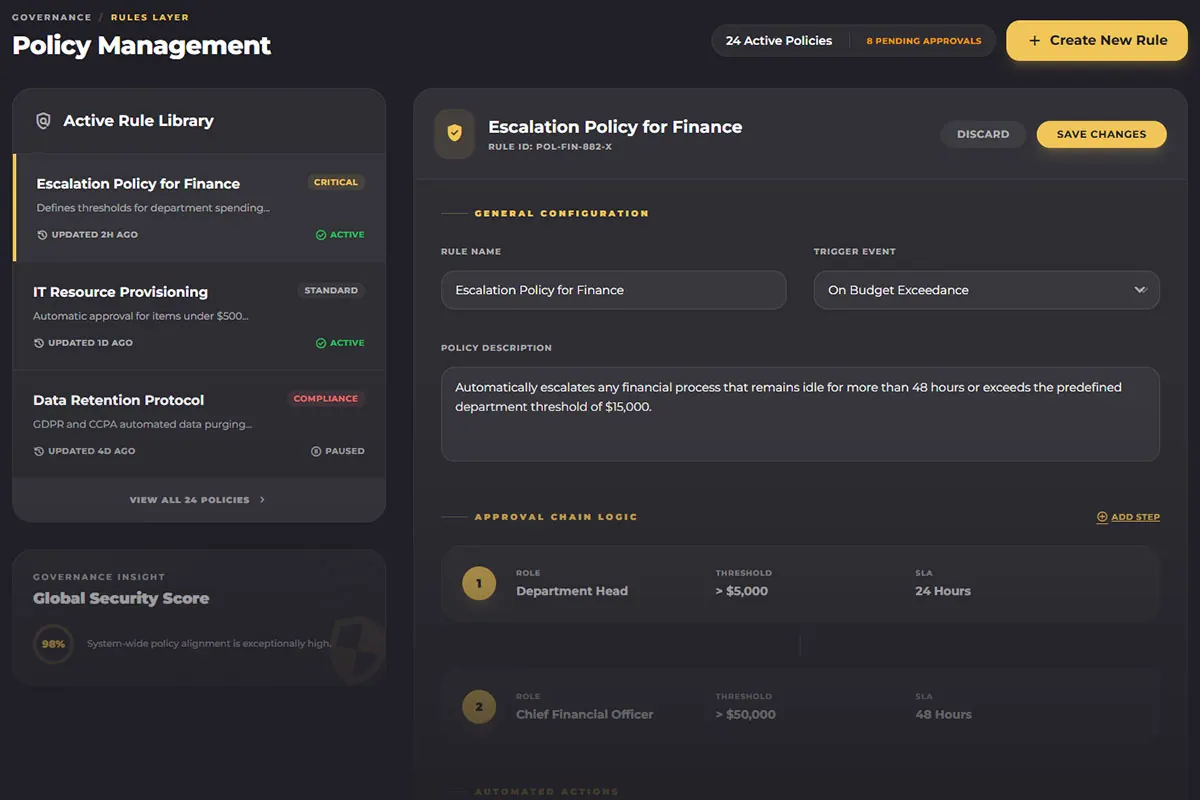
Governance Rules Layer
Configure policies, approval chains, escalation thresholds, and compliance requirements applied to every workflow execution.
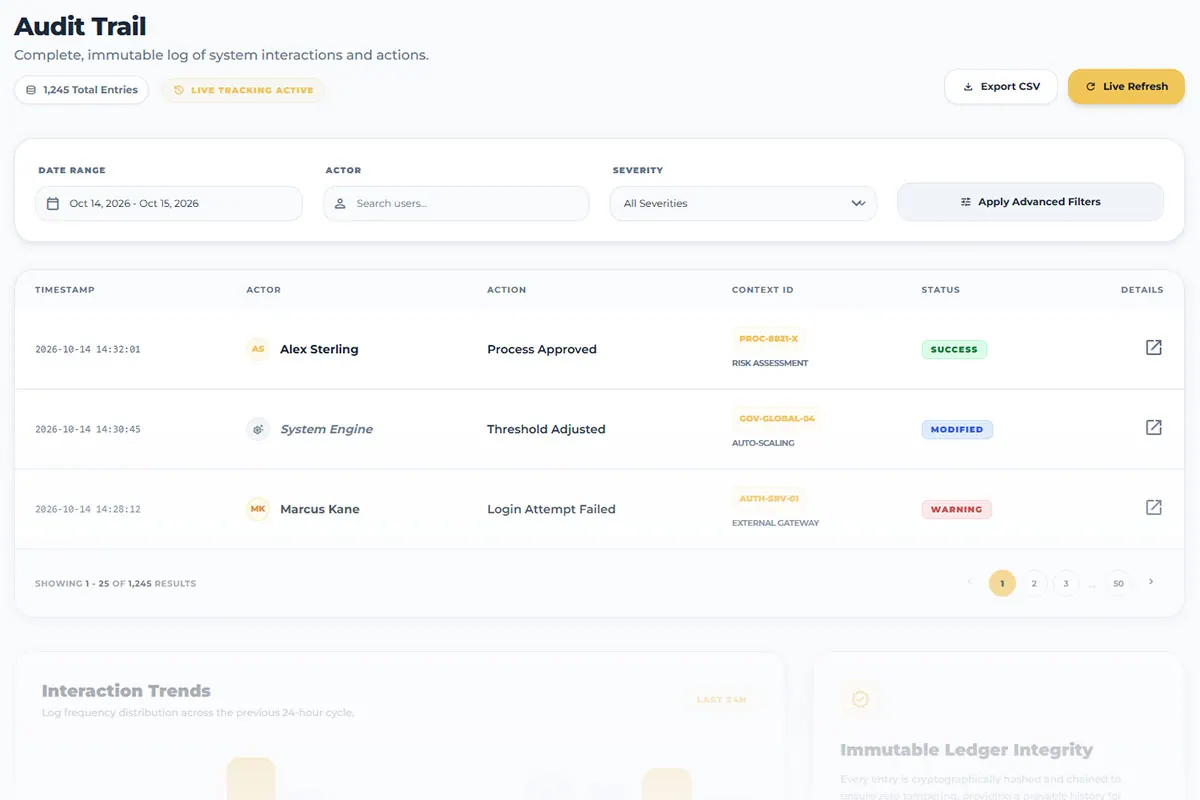
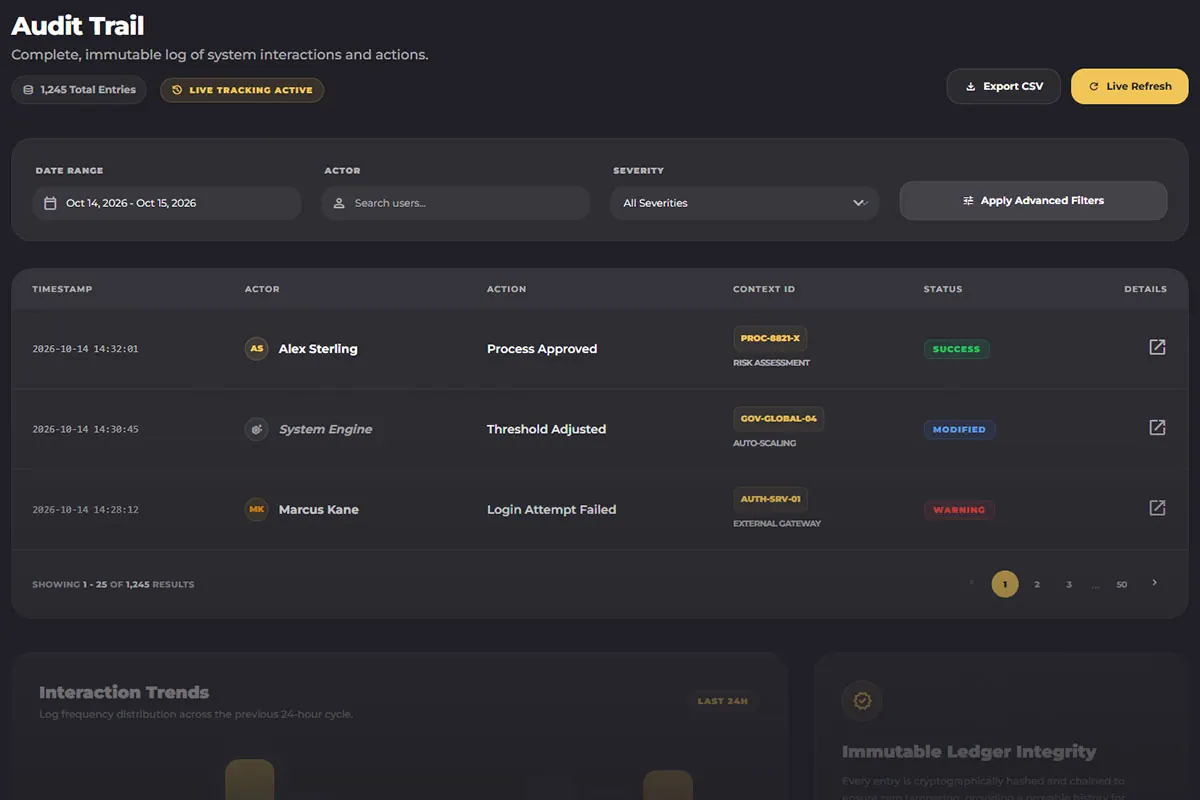
Audit Trail View
Complete, immutable log of every action, decision, and system interaction with full attribution and contextual detail.
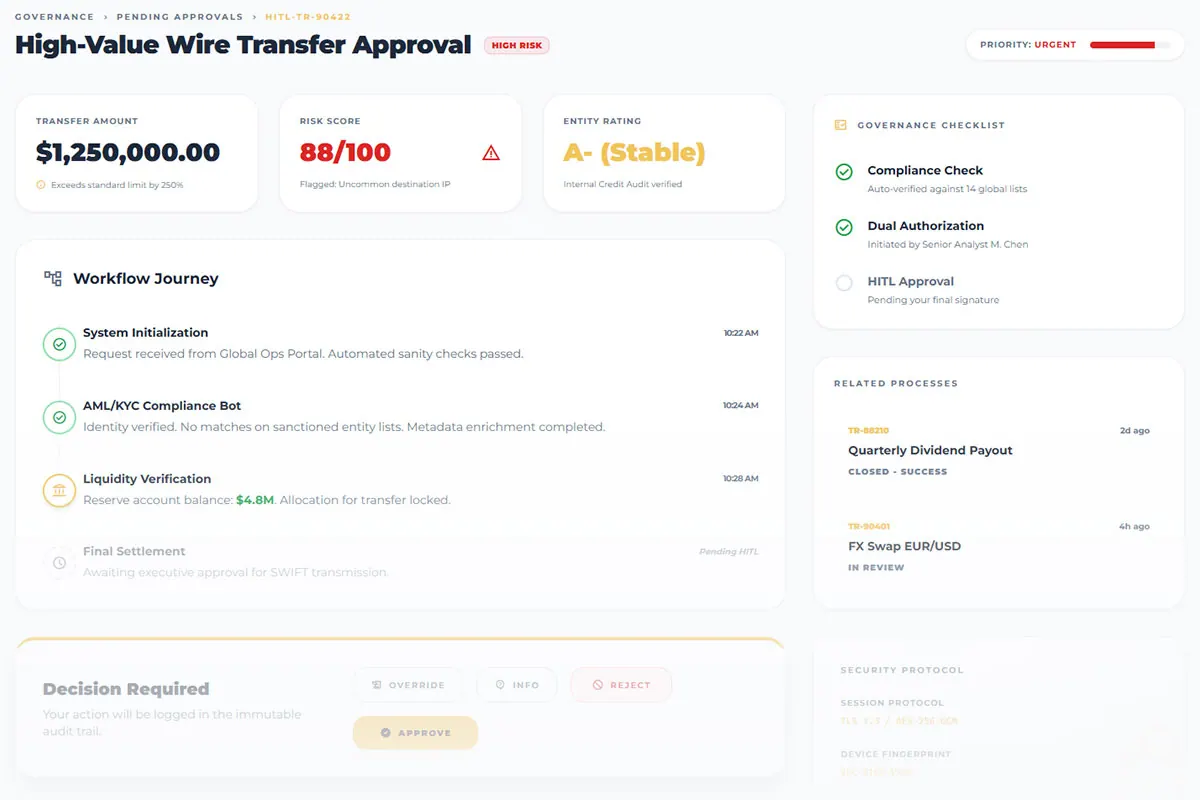
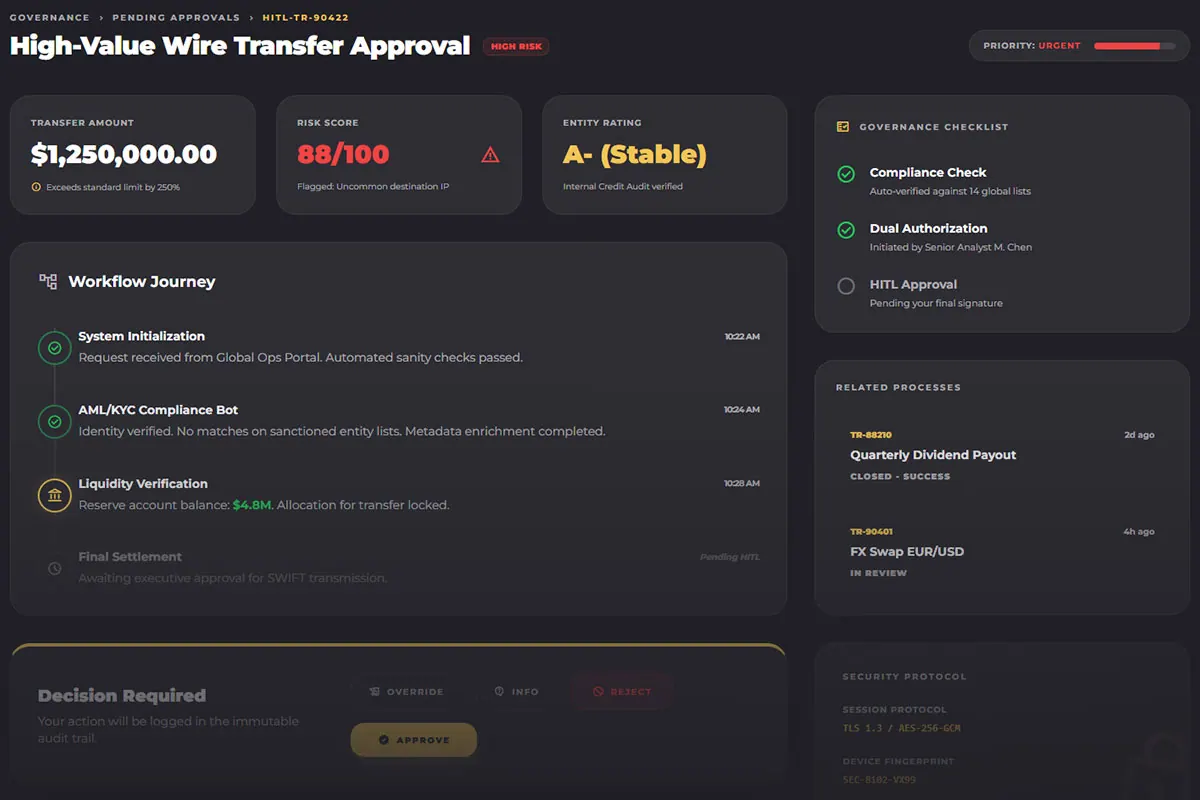
Human-in-the-Loop Decision Point
Structured interface for human review, approval, and override at critical workflow stages with full decision context.
Platform Capabilities
Everything enterprise operations demand. Nothing they don't.
Workflow Orchestration
Design and execute complex multi-step workflows spanning departments, systems, and decision points.
Document Operations
Intake, classify, validate, route, and review documents as first-class workflow participants with retention and audit built in.
Enterprise Integrations
Connect ERP, CRM, case platforms, repositories, and APIs into a single governed execution flow — without replacing existing systems.
Human-in-the-Loop Control
Embed approvals, reviews, overrides, and escalation paths at the exact workflow steps where human authority is required.
Robot / RPA Orchestration
Coordinate attended and unattended automation workers — bots, scripts, RPA platforms — as governed participants inside the workflow.
Governed AI Agent Participation
Let AI agents classify, score, summarize, or recommend inside bounded tasks — with scoped inputs, validated outputs, and human review where required.
Policy Enforcement
Routing rules, approval gates, role-based access, and compliance constraints applied at runtime — not reviewed after the fact.
Audit-Ready Traceability
Immutable record of every decision, AI output, bot action, and human approval — queryable and complete without reconstruction.
Operational Intelligence
Real-time monitoring, SLA tracking, bottleneck detection, and governance dashboards across every workflow participant.
Where It Works
Governed orchestration for the operations that matter most.
BPMS.Ai is deployed in operational contexts where complexity, compliance, and cross-functional coordination are non-negotiable — not in simple task automations that any tool can handle.
Supplier Onboarding
Structured qualification, document collection, approval routing, and compliance verification — governed end to end.
Learn moreCredit Operations
End-to-end credit assessment with policy enforcement, human review gates, and full decision traceability.
Learn moreCase Management
Dynamic case routing, task assignment, escalation handling, and resolution tracking across teams and systems.
Learn moreDocument-Heavy Workflows
Automated document intake, classification, extraction, review, and approval with governance controls at every step.
Learn moreSolutions
Solutions built from real operational patterns.
BPMS.Ai is not designed around a single industry or one local customer base. It is built from recurring operational patterns found across enterprise workflows: documents, approvals, exceptions, integrations, robots, AI-assisted steps, audit trails, and human accountability.
Financial Operations
Operational problem
Factoring, onboarding, due diligence, invoice review, payment orchestration, and reconciliation spread across portals, ERP/core, and back-office teams.
How BPMS.Ai helps
Coordinates the workflow layer across portals, ERP/core systems, RPA bots, document operations, approval rules, and reporting.
Typical actors
Back-office analysts, risk and compliance reviewers, ERP/core systems, document repositories, RPA workers, AI-assisted steps.
Public Sector Operations
Operational problem
Citizen requests, administrative procedures, document-heavy case files, and inter-department routing handled with limited visibility and SLA accountability.
How BPMS.Ai helps
Configured as GovernAPP Pro: PQRSFD workflows configured on BPMS.Ai, citizen request intake, document routing, SLA tracking, and audit-ready case history.
Typical actors
Citizen-facing intake channels, case officers, legal and compliance reviewers, document repositories, inter-department coordinators.
Service Desk Operations
Operational problem
Service requests, incidents, and operational tickets that need governed routing, SLA tracking, escalation, and traceable resolution across teams and systems.
How BPMS.Ai helps
Turns ticket and channel events into governed workflows with SLA monitoring, escalation, policy enforcement, and full case history.
Typical actors
Service desk agents, supervisors, integrated systems and bots, AI-assisted drafting, escalation owners.
Document-Heavy Workflows
Operational problem
Intake, classification, validation, review, and approval of high volumes of documents across business units.
How BPMS.Ai helps
Structures the full document lifecycle as governed workflows with extraction, validation, human review gates, and audit trails.
Typical actors
Document operators, reviewers, AI extraction and classification, repositories, approvers.
Robot-Governed Operations
Operational problem
RPA bots running across processes with limited control over when they run, what they touch, what happens on failure, and how outcomes are logged.
How BPMS.Ai helps
Governs robot execution inside the business process — trigger conditions, permissions, validations, retries, exceptions, human escalation, and execution logs.
Typical actors
RPA bots, bot supervisors, business process owners, exception reviewers, audit and operations teams.
Workflow Modernization
Operational problem
Legacy workflows with UX friction, fragmented integrations, limited reporting, and unclear governance — blocking automation and AI readiness.
How BPMS.Ai helps
A consultative engagement that reviews current workflows, integration architecture, document operations, governance gaps, and proposes a modernization path executed on BPMS.Ai.
Typical actors
Operational architects, enterprise architects, process owners, IT and security stakeholders.
AI Agent Governance
Operational problem
AI agents introduced into operations without scope, review gates, data boundaries, or traceability — creating risk instead of value.
How BPMS.Ai helps
Lets AI agents participate inside bounded workflow tasks with scope, allowed data sources, confidence thresholds, mandatory human review, and full logging.
Typical actors
AI agents, human reviewers, risk and compliance owners, workflow designers, audit teams.
Differentiation
Why existing tools leave governance gaps.
Traditional BPM gives you structure without intelligence. AI agent stacks give you intelligence without control. Patchwork orchestration creates integration without governance. BPMS.Ai is the enterprise answer — governed orchestration with AI built in.
| Capability | Traditional BPM | AI Agent Stacks | Patchwork Tools | BPMS.Ai |
|---|---|---|---|---|
| Governed workflow execution | ||||
| AI agent integration with bounded autonomy | ||||
| Human-in-the-loop at execution time | ||||
| End-to-end traceability by design | ||||
| Policy enforcement during execution | ||||
| Enterprise system integration | ||||
| Governance as execution model | ||||
| Operational intelligence and monitoring | ||||
| Production-grade scalability |
Governance by Design
Governance is not an add-on. It is part of execution.
Every workflow in BPMS.Ai executes within a governance framework that ensures compliance, accountability, and operational control from the first step to the last.
Bounded autonomy
AI agents operate within defined boundaries — scope, duration, and decision limits are set before execution begins.
Human escalation
Workflows automatically route to human decision-makers when thresholds are crossed or exceptions arise.
Policy enforcement
Business rules, compliance requirements, and operational policies are enforced at every workflow step.
Full traceability
Every action, decision, and system interaction is logged with complete context and attribution.
Controlled change
Workflow modifications follow governed change management with versioning, approval, and rollback capabilities.
BPMS.Ai
BPMS.Ai
Built from real experience
Built from real enterprise workflow implementation experience.
Built from real enterprise workflow implementation experience across financial operations, public-sector case handling, service desk operations, document-heavy processes, RPA-supported workflows, and integration-heavy environments. The platform reflects what real operations require — not abstract product claims.
BPMS.Ai is designed around the operational patterns enterprises actually run — document-heavy workflows, approvals, escalations, multi-system handoffs, audit trails, AI-assisted steps under governance, and clear human accountability — and is being prepared for regional and international go-to-market.
Operational patterns the platform is designed around
Document-heavy workflows
Intake, classification, validation, routing, and review of documents at operational scale.
Approvals and escalations
Structured approval chains, exception handling, and escalation paths across teams and systems.
Multi-system handoffs
Work moving across ERP, CRM, case systems, document repositories, and external services in a coordinated way.
Audit trails and accountability
Structured logs of decisions, actions, and reviewers so accountability is explicit rather than reconstructed.
Current modernization focus strengthening the foundation
API-first architecture
Capabilities exposed as structured services for clean integration and predictable orchestration.
Decoupled frontend
Operator experience modernized as an independent layer over the orchestration core.
Backend modernization
Strengthened execution core for governed routing, policies, and exceptions during runtime.
AI-native workflow governance
AI agents participate inside bounded workflow tasks with scope, review gates, and traceability.
Conservative proof. No invented logos, client counts, workflow counts, document counts, certifications, ROI percentages, or named case studies. Public customer evidence and approved case studies will be added only when formally cleared for publication.
Why now
Why governed orchestration matters now.
The shift to AI-assisted operations is exposing a control gap that traditional BPM and standalone automation tools were never designed to close.
AI, bots, and APIs are being added faster than they can be governed
Enterprises are introducing AI agents, RPA bots, automation scripts, and new APIs at a pace that outruns the existing operating model. Adoption is moving faster than control.
Fragmented automation creates operational risk
When work crosses teams, systems, documents, and decision points, isolated bots and disconnected workflows quietly accumulate handoff failures, blind spots, and accountability gaps.
AI without workflow governance creates audit and accountability gaps
AI agents acting outside structured workflows produce outputs no one can trace back to a policy, a reviewer, or a decision boundary — exactly where regulators and executives expect clarity.
Governed orchestration lets enterprises scale automation without losing control
BPMS.Ai helps organizations expand automation and AI participation while preserving policy enforcement, traceability, human accountability, and exception handling inside the workflow itself.
How We Deploy
Enterprise deployment, not self-serve setup.
BPMS.Ai is deployed through a structured enterprise engagement — from understanding your operating reality to delivering governed execution.
Understand the operating pain
We map your operational challenges, governance gaps, and process complexity.
Design the operating model
Together, we define target workflow architecture — participants, policies, escalation paths, integrations.
Implement and integrate
We deploy BPMS.Ai into your environment, connect systems, and validate the execution model.
Support change management
Structured onboarding, stakeholder alignment, and operational support for lasting adoption.